How the northern wastewater tunnel is built – step by step
The northern wastewater tunnel will run from Källby in Lund to the Sjölunda wastewater treatment plant in Malmö, connecting along the way the municipalities of Burlöv and Lomma, as well as Hjärup in Staffanstorp municipality.
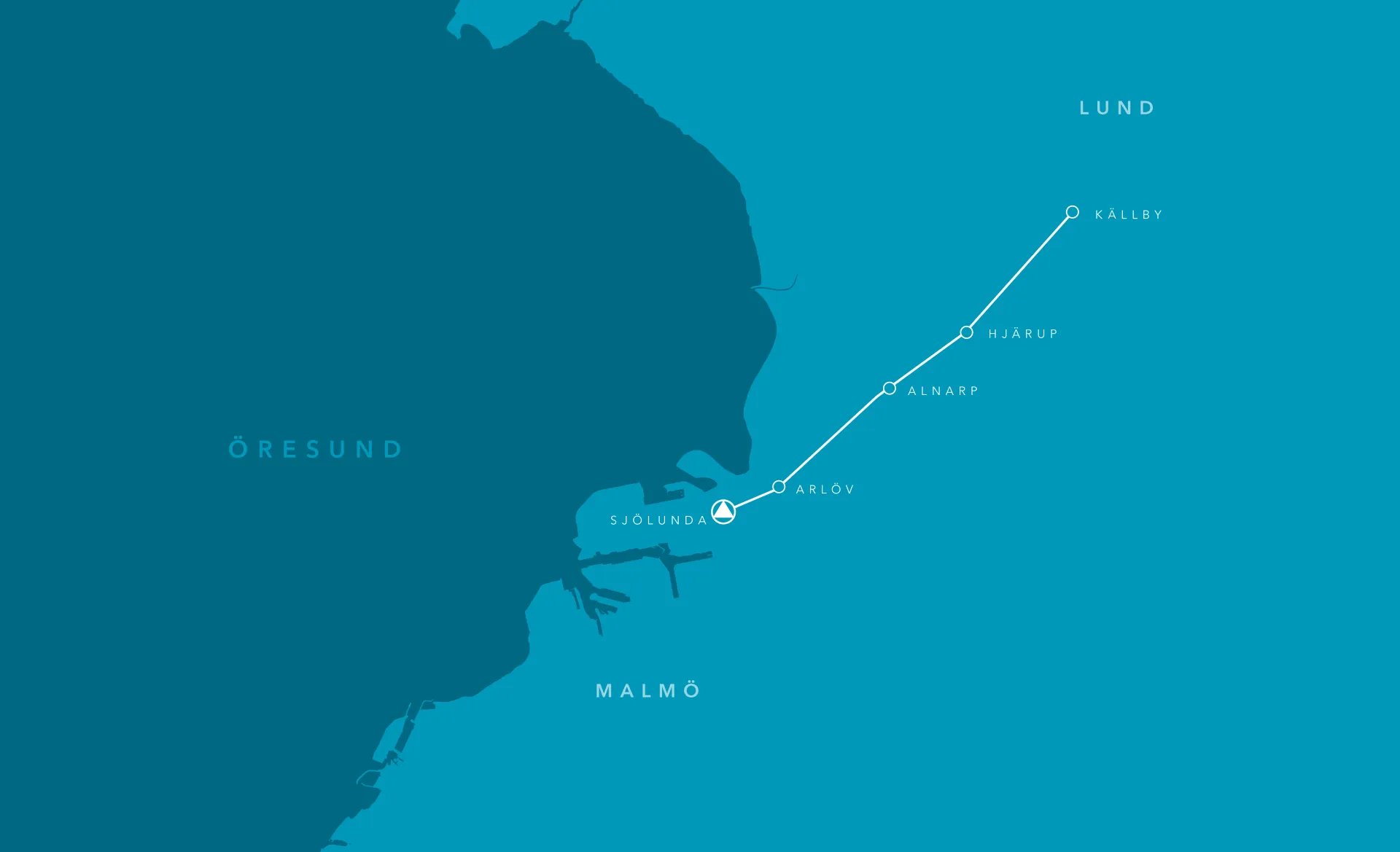
The tunnel will be built in four stages – here’s how it works and how the surroundings are affected:
1.Preparing the ground
How it works
The ground where the shafts will be constructed must be carefully prepared before construction can begin. The area is first fenced off and measures are taken to ensure that traffic flows around the site function properly. The work area is cleared, any utilities that need to be relocated are moved, and preliminary excavation is carried out to a depth of a few meters to check for obstacles, contaminated soil, or anything else that could risk delaying construction.
When does this happen?
When tunneling, the boring machine needs to be lowered into a special launch shaft, which is often built first and is larger than the other shafts. For the northern tunnel, the launch shaft will be located at Alnarp, and ground works are planned to begin here no earlier than the end of 2027. This will be followed by preparing work areas for the shafts in Arlöv, Hjärup, and Källby.
Impact on surroundings
During daytime, some construction noise may occur near the work areas. Traffic on connecting major roads may periodically increase throughout the construction period due to transport to and from the site, and minor traffic disruptions may occur.
VA SYD has the option, if necessary, to temporarily close the on-ramp to the E6 by the Alnarp shaft during the construction period, but this will only occur on short occasions. Residents in the nearby area have expressed that the on-ramp is important to them, which VA SYD is taking into account in the planning. No other road closures are planned.
2.Construction of shafts
How it works
The launch shaft at Alnarp is built first, followed by the shafts at Arlöv, Hjärup, and Källby. The work begins by constructing a support structure forming the shaft wall, using either diaphragm wall technology or secant piles. Once the shaft wall is sealed, the shaft is excavated down to the required level.
When and for how long?
The plan is to begin constructing the launch shaft at Alnarp no earlier than 2028, followed by the other shafts. Each shaft takes about 6–12 months to build, and activity will continue at each shaft throughout the entire tunneling period.
Impact on surroundings
Work at the shafts is carried out in different phases throughout the construction period. During active phases, noise and vibrations may occur near the shafts, along with transport to and from the site. The total duration of work at each shaft is 2–5 years, depending on type of shaft. At the shafts located near residential areas, the noisiest activities last for 3–6 months depending on shaft size. At the launch shaft in Alnarp, activities will continue throughout the entire construction period.
The most noise-intensive activities will take place during daytime (07:00–19:00), but some work may need to be carried out in the evening or at night. With protective measures in place, noise levels will in most cases comply with the Swedish Environmental Protection Agency’s requirements. Before noisy activities are carried out, VA SYD will inform nearby residents. Updated information is also always available on VA SYD’s website under “Operational Information.”
3.Tunnel boring
How it works
At the launch shaft in Alnarp, the tunnel boring machine is lowered, and the tunnel is first bored southward to the shaft at Arlöv and to the large shaft where the Sjölunda pumping station will later be built. There, the tunnel boring machine is retrieved and transported back to the launch shaft, where it is lowered again and bores northward to the shaft at Hjärup and then to the shaft at Källby, where the machine is retrieved.
All excavated material is moved backward through the tunnel to the launch shaft, where it is brought to the surface and transported away for handling in accordance with regulations.
When and for how long?
Tunnel boring is planned to begin no earlier than 2029 and will continue through 2032.
Impact on surroundings
Since the tunnels are bored at a depth of 20–35 meters using well-established methods, the assessment is that no existing buildings above the tunnel route will be affected, neither during construction nor afterward.
Residents directly above the tunnel route may hear a low, rumbling structural sound* for about one week as the tunnel boring machine passes approximately far down below ground. The machine advances about 15–20 meters per day. Once it has passed, no further disturbance will occur, neither during construction nor operation.
*Structural sound refers to noise from an activity (such as tunnel boring) that travels through solid materials (such as hard soil or rock) into a building’s structure, creating a low-frequency sound.
What determines the tunnel alignment?
The location of the shafts and the tunnel alignment is the result of thorough investigations aimed at minimising overall impact on the surroundings. The selected alignment is the shortest possible route considering connections to existing pumping stations, which are key nodes in the pipe network at ground level, and is therefore the most time- and cost-efficient.
This approach avoids the need for investments in long pressurised pipes and additional pumping stations to connect the existing pipe network, which would also have caused disruption for traffic and agricultural activities. Minimising material needs and the volume of excavated tunnel material also reduces the number of transport movements.
4.Completion of construction
How it works
Once the tunnel is complete and the shafts have served their purpose during the construction phase, around 2032, these will be closed and left dormant for a couple of years while awaiting completion of the Sjölunda pumping station and wastewater treatment plant. Then the existing pipe network will be connected, around 2035. What remains above ground may be a small building and/or hatches providing access for service and maintenance.
Impact on surroundings
Some noise may occur, along with increased traffic from transport to and from the work site. No road closures are planned, but short-term closures may occur, for example when connecting to the existing pipe network.